
Anyone who has walked down a stretch of Canal Street or through the Diamond District has seen the signs. "We Buy Gold." "Cash for Gold and Diamonds." "Pawn Loans Available." From the sidewalk, a pawn shop and a direct gold buyer can look like the same business wearing a different shirt. They are not. The way each one makes money is fundamentally different, and that difference almost always shows up in the number you are offered for your jewelry. If you are trying to decide where to sell in New York City, understanding that distinction is worth ten minutes before you walk in anywhere.
The Fundamental Difference: Buying vs Lending
A pawn shop is, at its core, a short-term lender. Its business model depends on you not being able to repay the loan on time, because the interest and fees on a pawn loan are where the shop actually earns its money. When you bring in a gold chain or a diamond ring, the pawnbroker is not really trying to figure out what it is worth to a refiner or a jeweler. They are trying to figure out the smallest amount they can lend you that still lets them cover their risk if you never come back for it. That number is almost always well below the item's actual melt or resale value, because the shop needs room to profit even in a worst-case scenario.
A direct buyer works from the opposite direction. There is no loan, no ticket, and no 90 or 120 day clock ticking on your item sitting in a back room. The transaction is a straight purchase: you hand over the piece, we determine what the gold, diamonds, or watch components are actually worth based on live market rates, and we pay you that amount outright. Because the buyer's profit comes from correctly valuing and reselling or refining the material rather than from fees on an unpaid loan, there is a natural incentive to offer closer to true market value in the first place.
How Pawn Shops Make Money
Pawn shop revenue comes from three places: interest on loans, fees for storage and paperwork, and profit on items that go unclaimed and get sold in the shop. Because so much of their model depends on borrowers defaulting, the initial loan offer is deliberately conservative. A shop might offer you 30 to 50 percent of an item's resale value as a loan amount, then charge monthly interest on top of that. If you do not redeem it, they keep the difference between what they loaned you and what the item is actually worth.
How a Direct Refiner Makes Money
A refiner or direct buyer makes money by accurately assessing metal content, diamond quality, or watch authenticity, then either reselling the piece or, in the case of gold, processing it through refining to recover the pure metal. Because there is no interest income to fall back on, the offer has to be reasonably close to the item's real value or the buyer simply would not be able to compete for customers. This is the core reason an in-house refiner at a location like ours on Bowery can typically offer more than a pawn loan for the same piece of gold.
Side by Side: What Changes for You
- Transaction type. A pawn shop may offer a loan or a purchase. A direct buyer makes a purchase offer, and if you accept, the sale is final and complete.
- Pricing basis. Pawn offers are built around resale and loan risk. A direct buyer prices gold on its metal content at current market rates.
- Specialization. A general pawn shop handles many categories. A buyer focused on gold, watches, diamonds and jewelry evaluates those items every day.
- Interest and fees. A loan carries interest and sometimes storage or paperwork fees. A straightforward sale does not.
- Speed. Both can move quickly, but a direct buyer can typically appraise most items in about 20 minutes and pay the same day.
Why Pawn Shop Offers Are Usually Lower
Even when a pawnbroker offers to buy an item outright rather than loan against it, the pricing model tends to carry over old habits. Staff are often trained to quote conservatively because the shop's inventory system and cash flow are built around lending, not buying. There is also usually a middleman step: many pawn shops do not refine gold themselves, so they sell scrap gold in bulk to a third-party refiner and take a cut in between. That cut comes directly out of what they can afford to pay you.
Diamonds and watches follow a similar pattern. A pawnbroker handling hundreds of different product categories, from power tools to guitars to jewelry, rarely has a certified gemologist or a watch specialist on staff who can properly grade a stone or verify whether a Rolex movement is genuine. Without that expertise, the safe move for the shop is to lowball the offer to protect against the risk of overpaying for something they misjudged. You end up absorbing that uncertainty in the form of a smaller check.
The gap tends to be widest on the best gold. An 18k or 22k piece carries more gold in every gram, and a buyer pricing against the live market pays for that. A pawn counter's flatter, more conservative pricing often does not, which means the people who lose the most at a pawn shop are frequently the ones bringing in the highest-karat pieces.
What "In-House Refining" Actually Means for Your Payout
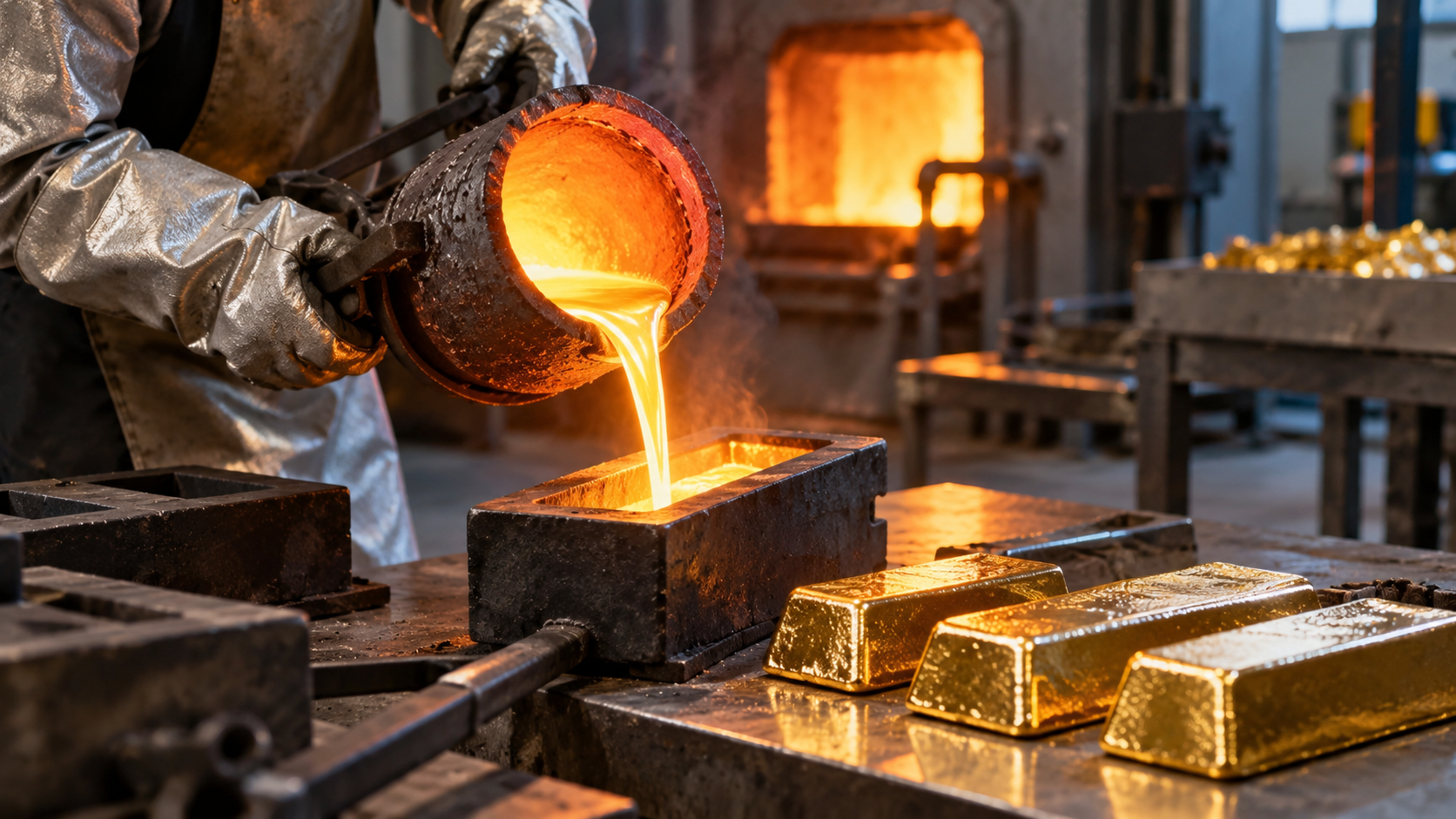
When a buyer refines gold in-house, there is no third party taking a percentage between your item and the final melt value. We test karat purity on site, weigh the piece, calculate the value based on the day's live spot price, and make an offer directly from that math. There is no broker fee, no shipping to an outside refinery, and no waiting period while material changes hands multiple times before it is turned into cash. The same logic applies to diamonds and watches: because we evaluate and resell these categories directly rather than routing them through several layers of buyers, more of the value stays with you, the seller.
This is also why appraisals at a specialized buyer tend to be faster and more precise than at a general pawn shop. Most items take about 20 minutes to assess properly, whether it is a gold bracelet, a loose diamond, or a luxury watch, because the person doing the appraisal handles this category of item all day, every day, rather than switching between jewelry, electronics, and musical instruments.
Speed, Cash, and Walking Away With Nothing to Repay
One real advantage of a pawn loan is that you technically keep ownership and can, in theory, get the item back. In practice, a large share of pawned items are never redeemed, either because the interest piles up faster than the borrower expected or because life gets in the way. If you already know you do not want the item back, a direct sale skips that entire structure. You walk in, get appraised, and walk out the same day with cash or a bank transfer and no loan balance hanging over you, no interest accruing, and no risk of losing a family piece to a missed payment deadline.
Protecting Yourself From Being Underpaid
Whether you choose a pawn shop or a direct buyer, a few habits protect you from leaving money on the table.
- Get more than one number. Manhattan has enough buyers within a short walk, from the Diamond District to the Financial District to Chinatown, that comparing two or three offers costs you almost nothing but time.
- Ask how the offer was calculated. A legitimate buyer should be able to explain karat purity, weight, and current spot price for gold, or walk you through the 4Cs for a diamond. Vague answers are a red flag.
- Bring documentation if you have it. Original boxes, papers, appraisal certificates, or receipts do not guarantee a higher offer on gold, but they can meaningfully help a diamond or watch valuation.
- Know that the appraisal should be free and no-obligation. You should never feel pressured to accept an offer on the spot, and a reputable buyer will not charge you just to look at your item.
A quick way to sanity-check any offer: ask what karat and weight they measured, then ask what today's spot price is. If those two numbers combined with a reasonable margin do not roughly match the offer, something in the math does not add up. For reference, 10k gold is about 41.7 percent pure, 14k about 58.3 percent, 18k is 75 percent, and 24k is essentially pure.
Questions to Ask at the Counter
- Are you buying this outright, or is this a loan? If the answer is vague, you may be looking at a pawn transaction dressed up as a sale.
- How are you testing the karat? A real buyer tests in front of you rather than just reading the stamp.
- Do you refine in-house, or resell to a third party? The answer tells you how many hands your gold passes through, and how many margins come out of your offer.
- When and how will I be paid? Same-day cash or bank transfer is standard for a serious buyer. Delayed payment or store credit deserves a second look.
When a Pawn Loan Might Actually Make Sense
To be fair, there is one scenario where a pawn shop genuinely fits better than an outright sale: you need short-term cash but fully intend to get the item back within a few weeks or months, and you are comfortable paying interest for that flexibility. If the piece has sentimental value and selling it outright is not something you are ready to do, a pawn loan buys you time. But if you already know you want to part with the gold, diamonds, or watch for good, a direct sale to a buyer who refines in-house almost always nets you more money with none of the interest or risk attached to a loan.
Selling With Ideal Refiners
If you are weighing your options in New York City, come see how a straightforward, no-pressure appraisal compares to a pawn counter quote. At Ideal Refiners, located at 70 Bowery #1.1 in Downtown Manhattan, we appraise gold, diamonds, fine jewelry, and luxury watches for free, most items in about 20 minutes, and pay the same day in cash or by bank transfer once you accept an offer. There is no loan, no ticket, and no obligation to sell if the number does not feel right to you. Bring a government-issued photo ID, as New York law requires it for these transactions, and stop by Monday through Thursday from 10am to 5pm or Friday from 10am to 3pm, or call ahead at (347) 970-1562 with any questions.