
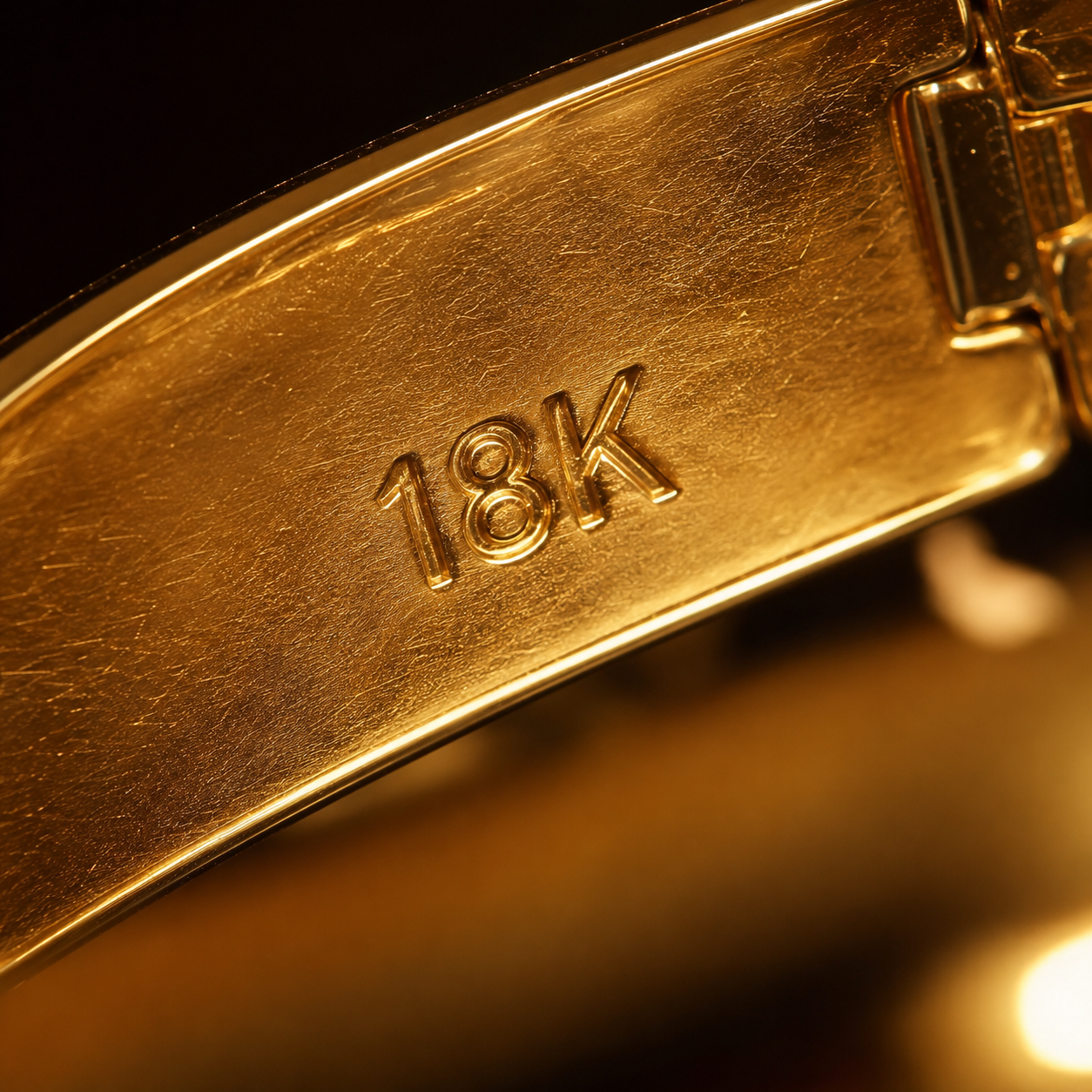
Most people who bring gold jewelry in to sell have a rough idea of what they own but very little idea of what it is actually worth. They know the piece is "14k" or "18k" because it says so on the clasp, and they know roughly how heavy it feels in the hand. What they usually do not know is how those two facts get translated into a dollar figure, or why two buyers on the same block in New York City might offer noticeably different amounts for the exact same bracelet. Understanding that math is the single best thing you can do before you sell, because it turns you from someone hoping for a fair number into someone who can recognize one when they hear it.
What "Karat" Actually Means
Karat is simply a measurement of purity, not a brand or a style. Pure gold is 24 karat, which means 24 out of 24 parts of the metal are gold with essentially nothing else mixed in. Anything below that number is an alloy, meaning gold has been blended with other metals like copper, silver, zinc, or nickel to change its color, hardness, or cost. So 18k gold is 18 parts gold and 6 parts other metal, which works out to 75 percent pure. 14k is 14 out of 24 parts, or about 58.3 percent pure. 10k, which is the lowest karat commonly sold in the United States, is about 41.7 percent pure.
This matters enormously for payout because you are never being paid for the whole weight of the item as if it were solid gold. You are being paid for the gold content inside that weight. A 10-gram chain stamped 10k contains roughly 4.17 grams of actual gold. The same 10-gram chain in 18k contains about 7.5 grams of actual gold, nearly double. That is why karat stamp and scale weight have to be read together, never separately, and why a heavier but lower-karat piece can sometimes be worth less than a lighter but higher-karat one.
Common Karat Stamps and What They Signal
- 24k / 999: Pure gold, soft, rarely used in everyday jewelry because it bends and scratches easily.
- 22k / 916: Common in South Asian and Middle Eastern bridal jewelry, very rich in color, high gold content.
- 18k / 750: A popular choice for fine jewelry and quality watches because it balances purity with durability.
- 14k / 585: The most common karat for everyday American jewelry, a practical middle ground.
- 10k / 417: The legal minimum karat that can be called "gold" in the U.S., more affordable but lower gold content.
Not every piece is stamped clearly, and stamps can also be worn smooth from decades of wear or, occasionally, misleading. That is one reason acid tests and electronic testing exist. A reputable buyer will test the metal in front of you rather than simply take the stamp at face value, because a mislabeled or unmarked piece deserves the same careful verification as one with a clean, legible stamp.
Weight, Then Purity, Then the Spot Price
Once purity is confirmed, weight is measured, almost always in grams on a calibrated scale, since that is the standard unit used in the gold trade. From there, the calculation is straightforward in principle: the item's pure gold content is multiplied against the current spot price of gold, which moves throughout the trading day based on global markets. The spot price is not something any single shop invents, it is a live, publicly tracked number, which means a legitimate buyer's offer should always be explainable in terms of today's spot price, not a vague "we'll see what we can do."
What differs from buyer to buyer is not the spot price itself but the percentage of that value they are willing to pay you, and how much they need to protect for their own margin. A pawn shop, for example, often needs a large spread because their business model is built around loans and resale, not refining. A retail jewelry store buying gold for resale needs room to mark it back up for the next customer. A middleman who buys from the public and then resells to an actual refinery needs their own cut layered in as well. Every one of those extra steps quietly shrinks what ends up in your hand.
What Does Not Affect Melt Value (and What Might)
Brand names, retail packaging and what you originally paid have no bearing on melt value. A gold chain from a well-known jeweler and one from a small shop in Chinatown are worth the same if they share the same karat and weight. Sentimental history matters to you, understandably, but it does not change what a refiner can recover from the metal.
A few things can move a piece into a different, higher category entirely. Designer jewelry from houses like Cartier, Van Cleef & Arpels or Tiffany can be worth more as a piece than as scrap, particularly in excellent condition. Estate pieces with unusual craftsmanship or antique settings sometimes fall into this category too. A knowledgeable buyer will flag this during the appraisal rather than melting something that is worth more intact.
Why Selling to a Refiner Changes the Math
Ideal Refiners buys directly and processes gold in-house, which removes an entire layer of middlemen from the transaction. We are not paying you a wholesale rate so that we can resell your jewelry at retail markup to someone else in the Diamond District or online. We are the end buyer. That structural difference is exactly why we are able to base offers closely on live market rates rather than a discounted number padded to cover a resale margin that, frankly, does not exist on our end.
This distinction matters more in a city like New York than almost anywhere else, because sellers here genuinely have options. You could walk your jewelry into a pawn shop in Chinatown, a small buyer near the Financial District, a big chain store, or a refiner like us near Bowery. All of them will hand you a number, but not all of those numbers are built the same way, and it is worth asking directly how a buyer arrives at their offer before you agree to anything.
Stones, Solder, and Non-Gold Parts
Gold jewelry is rarely 100 percent gold in practice. Rings have prongs holding diamonds or colored stones. Bracelets have clasps sometimes made of a different metal. Chains are occasionally soldered or repaired with lower-karat gold at some point in their life. A careful appraisal accounts for this by weighing components separately when practical, or by adjusting the calculation for known non-gold weight, so you are never being shortchanged for grams that were never gold to begin with, and also never accidentally underpaid because a stone was mistaken for scrap weight.
If your piece has diamonds or gemstones of real quality, it is also worth having those evaluated separately rather than assuming they add nothing beyond the gold's value. A well-cut, decent-sized diamond in an old setting can sometimes carry more value than the gold surrounding it. A competent appraisal separates these values out clearly rather than folding everything into one vague lump sum.
How to Avoid Being Underpaid
The most common mistake sellers make is accepting the first number offered without asking how it was calculated. A fair buyer should be able to tell you the karat they tested, the weight they measured, the spot price they are referencing, and the percentage of melt value their offer represents. If a buyer is cagey about any one of those four pieces of information, that is worth paying attention to. You do not need to be a metallurgist to sell gold responsibly, you just need a buyer willing to show their work.
It also helps to get more than one opinion, especially for larger or sentimental pieces. New York has enough gold buyers, from Chinatown to the Diamond District, that comparing two or three offers costs you little more than an afternoon and can meaningfully change what you walk away with. A buyer confident in their own pricing will not discourage you from shopping around, and one who pressures you to decide on the spot without comparison is often the one you should be most cautious with.
What to Bring In
Bring every piece you are considering selling, even ones you assume are "just costume jewelry," since stamps can be hidden under prongs or clasps and low-value looking pieces occasionally surprise people. Bring any documentation you have, such as original receipts, appraisal certificates, or GIA reports for pieces that include diamonds, since these can support a higher confidence in the appraisal even though gold itself does not require paperwork to sell. You will also need a valid government-issued photo ID, which is required under New York law for any transaction involving the purchase of precious metals, and there is no way around this requirement regardless of who you sell to.
Most gold appraisals at our office take about 20 minutes per item, sometimes less for straightforward pieces, and there is no obligation to accept the offer once we walk you through the numbers. We test the metal, weigh it on a calibrated scale in front of you, reference the live spot price, and explain exactly how we arrived at the figure we are offering. If it works for you, payment happens the same day, either in cash or by bank transfer, whichever you prefer.
Get a Real Number Instead of a Guess
If you have gold jewelry sitting in a drawer, whether it is a single tangled chain or a small collection built up over years, the only way to know its actual value is to have it properly tested and weighed rather than guessing based on the karat stamp alone. Ideal Refiners is located at 70 Bowery #1.1 in Downtown Manhattan, an easy stop whether you are coming from Chinatown, the Financial District, or anywhere else in the city. Stop in during our hours, Monday through Thursday from 10am to 5pm or Friday from 10am to 3pm, or call ahead at (347) 970-1562 if you would like to ask questions before you come in. There is no pressure and no obligation, just a clear, honest explanation of what your gold is worth today.